The Dry Night Protocol | A Clear Plan for Nigerian Families

Why Can Night-Wetting Continue at Nine, Eleven or Even Fifteen—After a Family Has Tried Almost Everything?

Discover the three patterns that can keep night-wetting going—and a structured, Nigeria-aware way to decide what to do next without shame, random remedies or impossible promises.

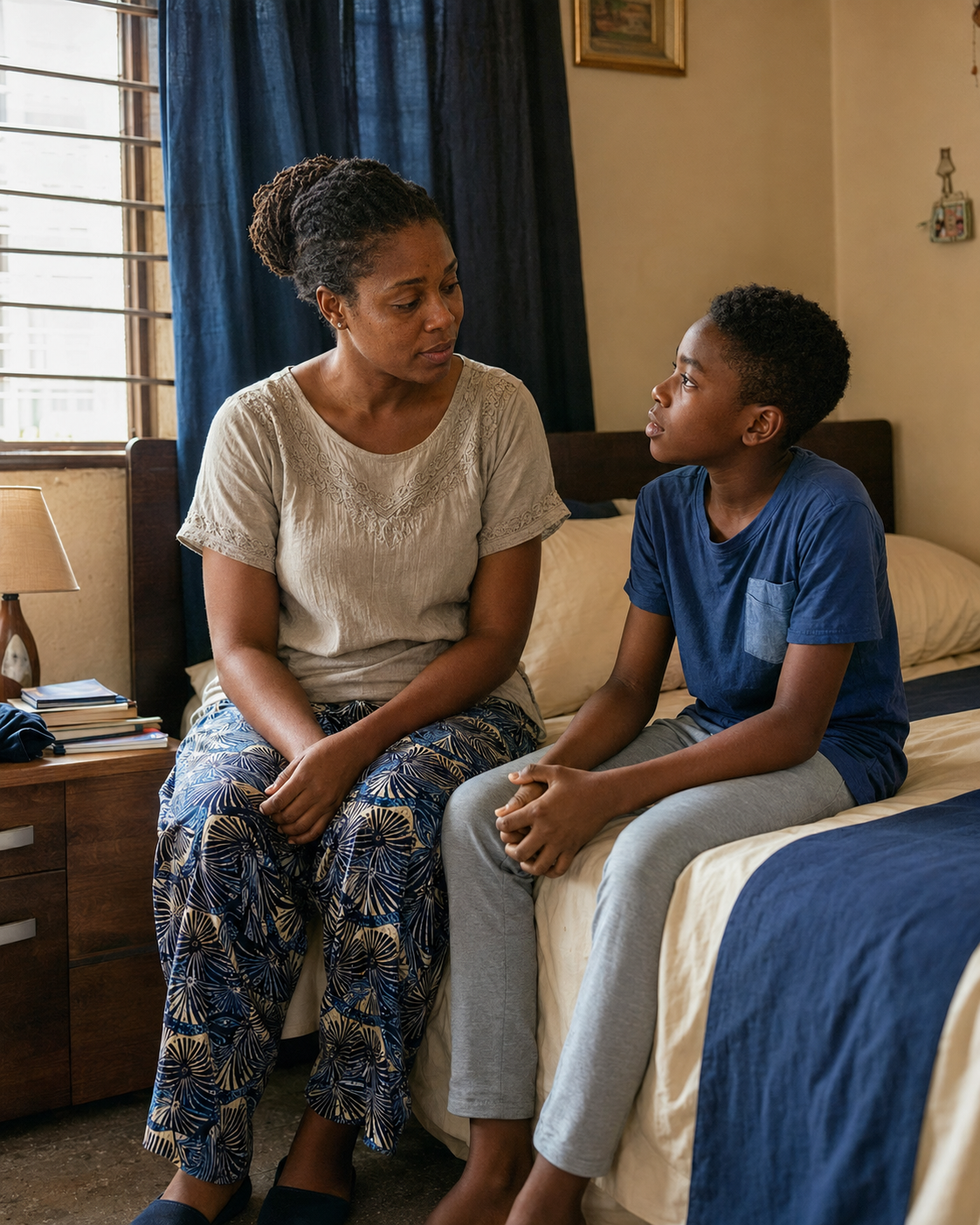
A Nigerian mother having a calm morning conversation with her child
Ages 5–15Research-informedNigeria-awareNo medicine dosesInstant digital access

It is rarely because a child is lazy, stubborn or unconcerned.

Night-wetting can begin in three different body systems. When the wrong system is targeted, years of effort can produce more arguments, more washing and very little useful change.

This page explains what those three systems are, why familiar methods often miss them, and how a family can replace guesswork with a structured plan.

The mornings can feel like two different households

On a wet morning, the sheet may disappear before breakfast. A pair of shorts gets pushed beneath other clothes in the laundry basket. The mattress is turned towards the wall or carried outside before the compound is fully awake.

Nobody needs to shout for a child to understand that this is something people are trying to hide.

Then a dry morning comes and the same child announces it before anybody asks:“Mummy, I was dry.”Lighter voice. Easier breakfast. A completely different morning.

That contrast can make the whole family believe the answer is more discipline, more effort or a bigger reward. But a sleeping child cannot decide what the kidneys produce, how much the bladder holds or whether the brain completes the process of waking.

The effort was never the missing part.
The same unanswered question

Maybe a school box is already sitting in the parlour and resumption is approaching. Maybe another Saturday has gone into airing a mattress, buying detergent and hearing yet another remedy.

Or perhaps the Nigerian research made it clear how many families manage this quietly without a proper explanation.

What is actually happening—and what is the correct order for dealing with it?

Something was never explained

Most families are not doing nothing. They are washing, waking, limiting drinks, buying remedies, turning mattresses and listening to everybody who says, “This worked in our own house.”

The Nigerian information gap is real

Many families manage it quietly. Very few ask a doctor.

In one survey of 448 caregivers in an urban Lagos community, 44.2% reported having at least one affected child, while only 1.3% had ever mentioned it to a doctor.

These figures belong to that particular study and are not a national prevalence estimate. The gap between home management and professional guidance is the important point.
44.2%reported an affected child
1.3%had mentioned it to a doctor

Studies across Nigeria report different rates because they examine different places and age groups, but the practical gap is familiar: many families are left with inherited advice rather than a clear explanation. Family history also appears repeatedly—not because a family has failed, but because the body systems involved can run in families.

A child may produce more urine overnight than the bladder can hold. Another may have reduced functional bladder capacity or daytime symptoms that need attention first. Another may receive the bladder signal during sleep but not wake in time. More than one system can be involved.

The useful question is not only “How do we stop the wet bed?” It is: “Which system appears to be involved, what can be observed at home, and what should happen next?”

Three different starting points

The same method cannot solve every pattern because every child is not starting from the same place.

01

Overnight volume

In some children, the kidneys produce more urine overnight than the bladder can comfortably hold. The clue may be one very large wetting episode or a heavily soaked bed alongside normal daytime toilet habits.

This is a volume question—not a discipline question.
02

Functional bladder capacity

Daytime frequency, sudden urgency, holding movements, damp underwear or several smaller wet patches can point towards reduced functional capacity or a daytime issue that needs attention first.

The daytime story matters even when the visible problem happens at night.
03

The wake-up response

The bladder sends a signal, but the brain does not complete waking in time. An alarm programme can target this learning process, but timing, full waking, repetition and consistency are what make it meaningful.

“Sleeping through anything” is not laziness. The child is asleep.

The guide calls these The Three Doors. It helps families organise observations and identify the route that deserves attention first. It is not a home diagnosis.

“No water after 6” is not a complete plan

There is a difference between adequate fluid spread through the day and heavy drinking just before bed.

Fluid restriction

Blanket restriction can leave a child thirsty, encourage secret drinking and reduce healthy daytime bladder filling. What matters is the full-day pattern.

Lifting

A half-asleep toilet trip may manage one moment without training the wake-up response that is needed.

Reward charts

Reward controllable behaviour, such as completing the routine—not a dry sheet produced while unconscious.

The bowel question

A daily bowel movement does not always settle the question. Consistency, withholding and incomplete emptying can matter.

Prayer and support

They can comfort a family, but should not replace checking medical warning signs or using an evidence-informed plan.

Before treatment comes the safety check

Some signs mean a home programme should pause and professional assessment should come first.

  • Wetting that begins again after six months or more of dryness
  • New daytime wetting
  • Pain or burning during urination
  • Heavy snoring, mouth-breathing or pauses in breathing
  • Continuous dribbling rather than separate wetting episodes
  • Weight loss, poor growth or unusual thirst
  • Sickle cell disease requiring coordination with the child’s healthcare team

For some children, this will be the most important section. That is the protocol doing its job.

A sequence is what changes the household

At 9pm on an ordinary school night, a family still needs practical answers:

What changes tonight?

What should be observed first?

Which warning signs mean stop?

When does an alarm belong in the plan?

What counts as early progress?

When should the family continue, adjust or see a doctor?

Those answers need to be arranged in the order they happen—not scattered across ten social-media posts.

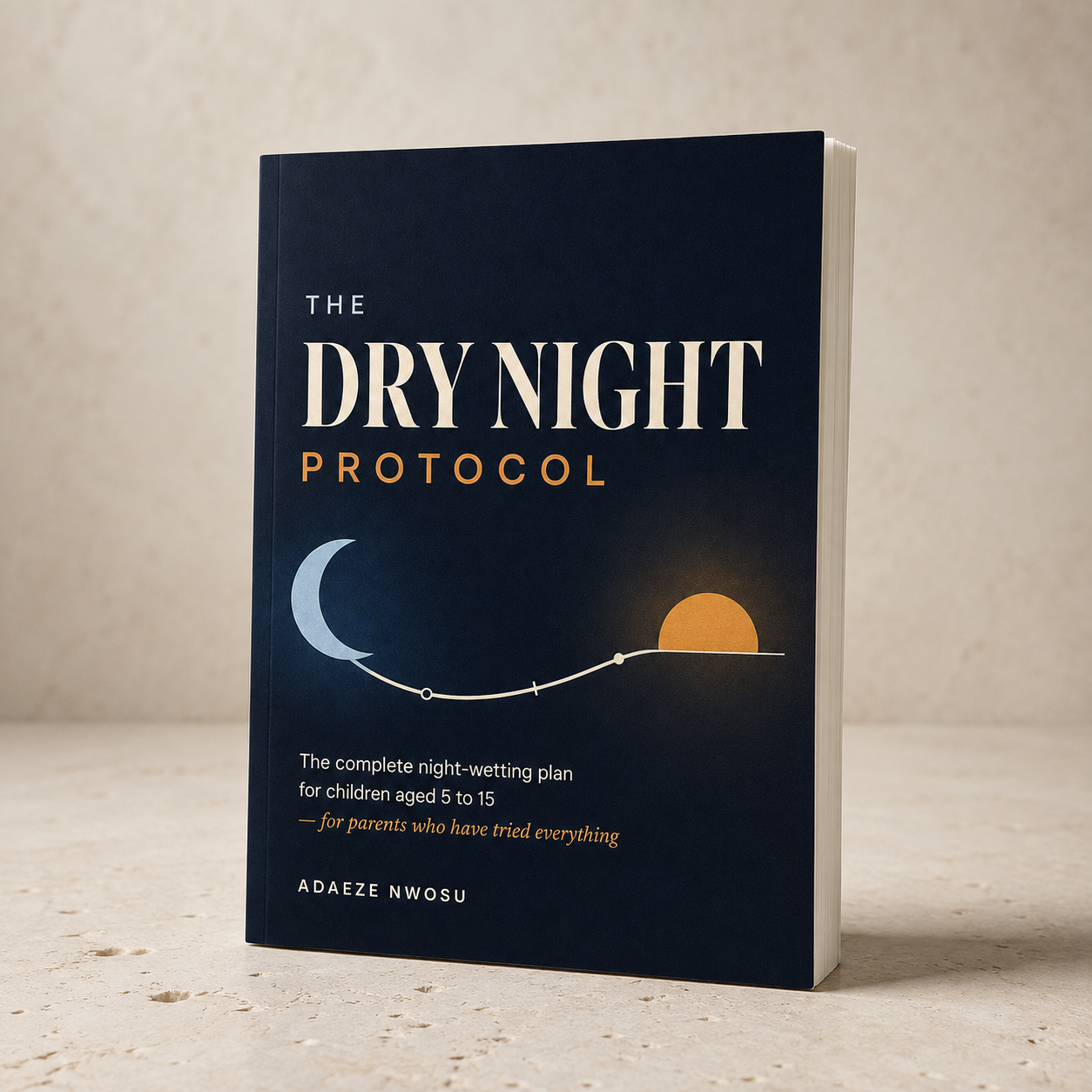
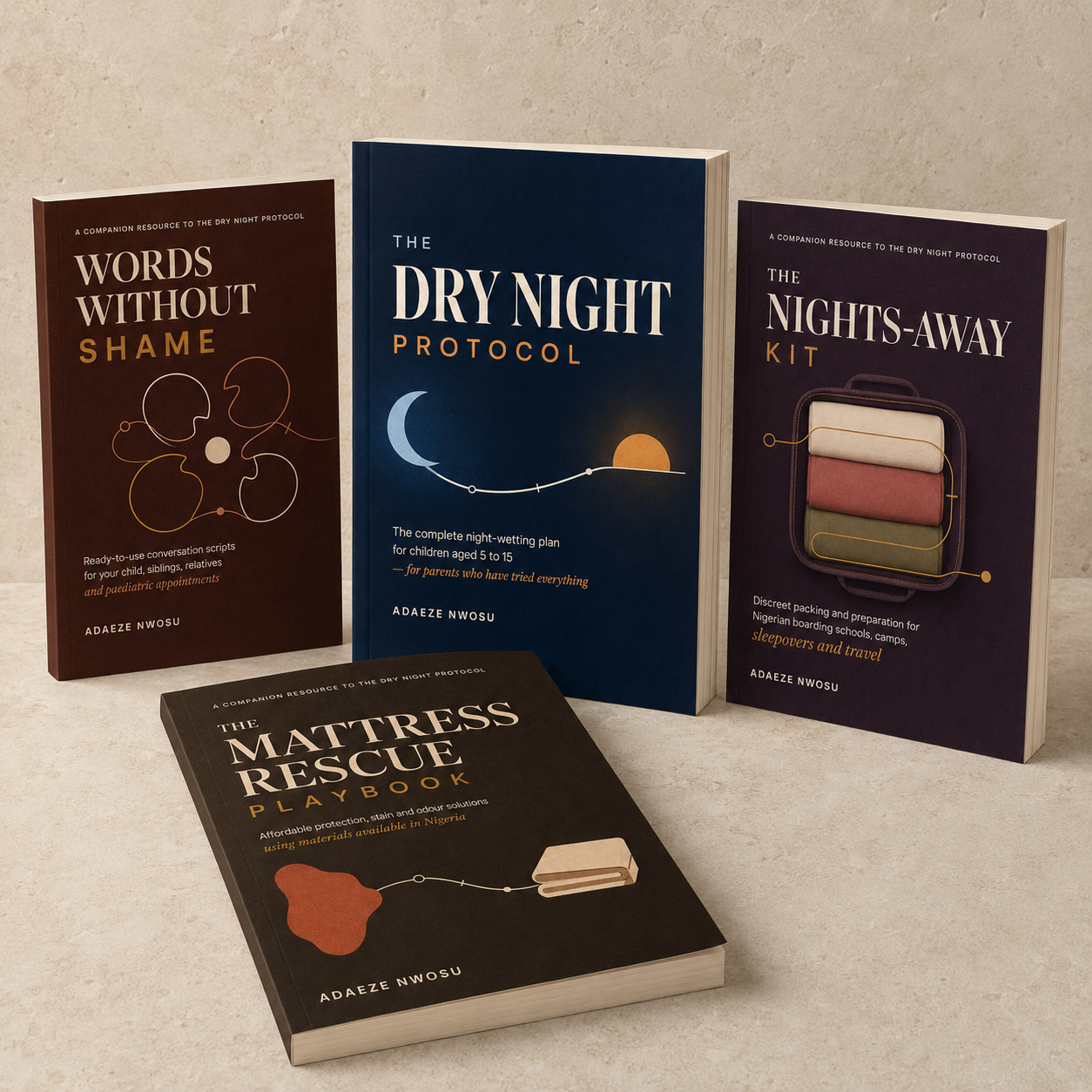
The Dry Night Protocol digital guide mockup

The Dry Night Protocol

The complete night-wetting plan for children aged 5 to 15—for parents who have tried everything.

A research-informed, practical system designed to help Nigerian families stop guessing and begin with a clear sequence. It does not promise a dry bed by a particular date.

  • Recognise when professional assessment should come before a home programme
  • Separate the likely patterns instead of treating every child the same way
  • Follow an age-appropriate sequence, including when an alarm may belong
  • Recognise meaningful progress before complete dryness appears
  • Know when to continue, adjust or take organised information to a doctor

67-page downloadable digital guide. The three companion bonuses are introduced separately below.

Six weeks of setting up and starting—not six weeks to a cure

Alarm learning commonly takes longer. The six-week structure gets the important pieces running correctly and helps reveal whether meaningful response markers are appearing.

01

Start safely

Check whether home action is appropriate and prepare the household without blame.

02

Understand the pattern

Gather the observations that matter instead of relying on one morning or memory.

03

Follow the right route

Use the age-specific routine that fits the likely pattern, with alarm guidance where appropriate.

04

Review before changing

Look for meaningful response and know when to continue, adjust or involve a doctor.

Important purchase disclosure

A body-worn moisture-triggered bedwetting alarm may be needed for families following that route. The alarm is not included. The guide explains when it may be appropriate, what type to look for and how to avoid using the wrong device.

A process built around decisions

The full working pages stay inside the guide, but the difference is clear from the structure.

  • Begin with the right question before choosing a route
  • Know what starts first, what comes later and what pauses the plan
  • Measure more than dry sheets and recognise early response
  • Treat safety, age and emotional wellbeing as part of the plan
  • Know when to continue, check consistency, change direction or involve a doctor
13

Practical tools kept inside the main guide

Structured schedules, tracking tools, decision guides and action plans turn the explanation into a process a family can follow. Their complete instructions are part of the paid protocol—not reproduced on this page.

The Dry Night Protocol

₦14,900₦9,800

No subscription. No recurring charge. No delivery fee.

Get The Dry Night Protocol₦9,800

Secure Selar checkout · Bank transfer or card · One-time payment · Immediate access

Three companion resources—free with the main product

School calendars still move. Mattresses still need protection. Children still hear comments from siblings and relatives. These resources handle the parts of life that continue while the main protocol does its work.

Free bonus 01

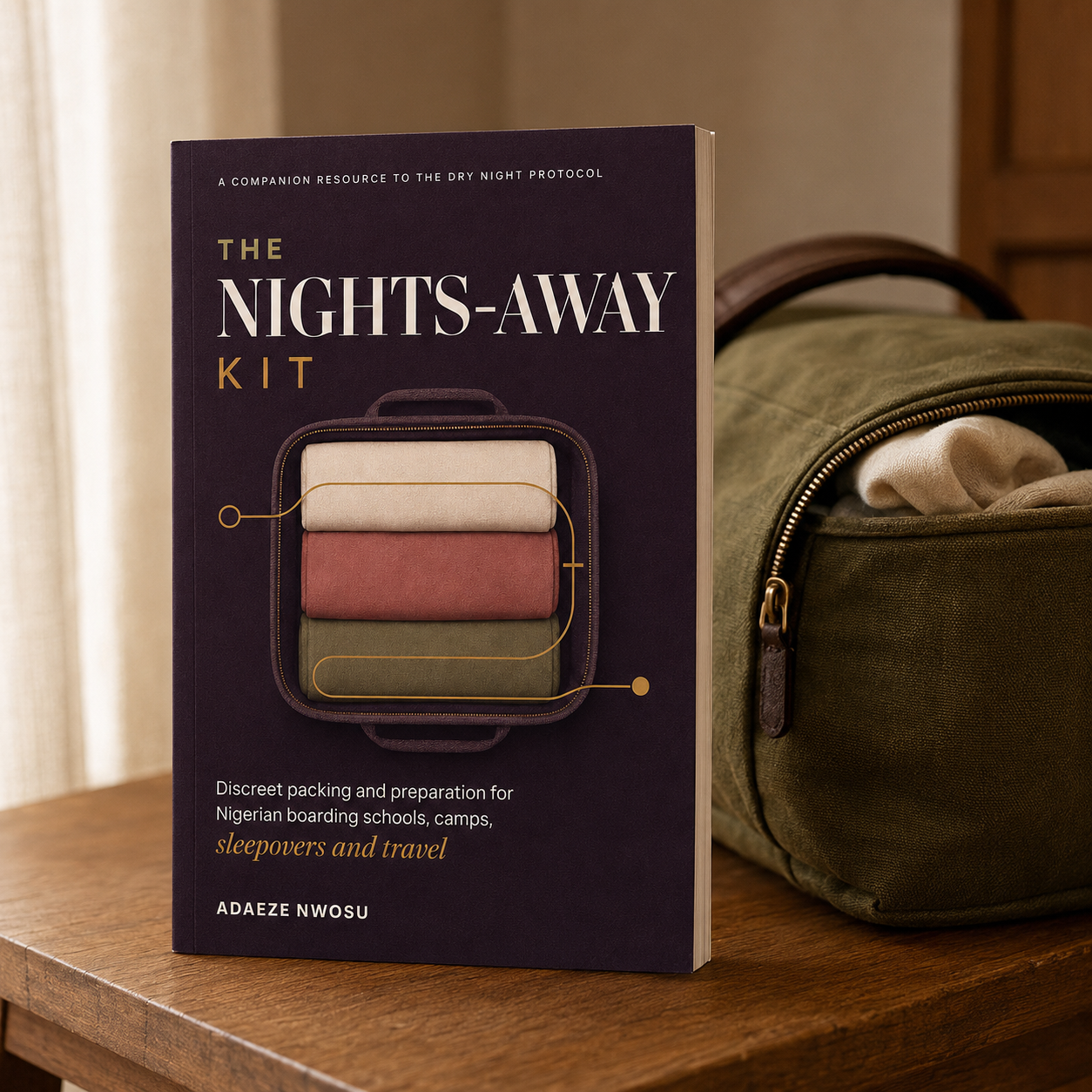
The Nights-Away Kit

Discreet preparation for boarding school, camps, sleepovers and travel.

The kit works whether or not the wetting has stopped. It helps a family prepare for the school calendar while the main protocol continues.

  • Pack discreetly without making the purpose obvious
  • Prepare the sleeping space and a trusted adult
  • Rehearse a private night routine at home
  • Handle awkward questions without exposing the child
  • Plan for boarding school, camp, sleepovers and travel

Standalone value₦6,500FREE today

The Nights-Away Kit digital guide mockup

Free bonus 02

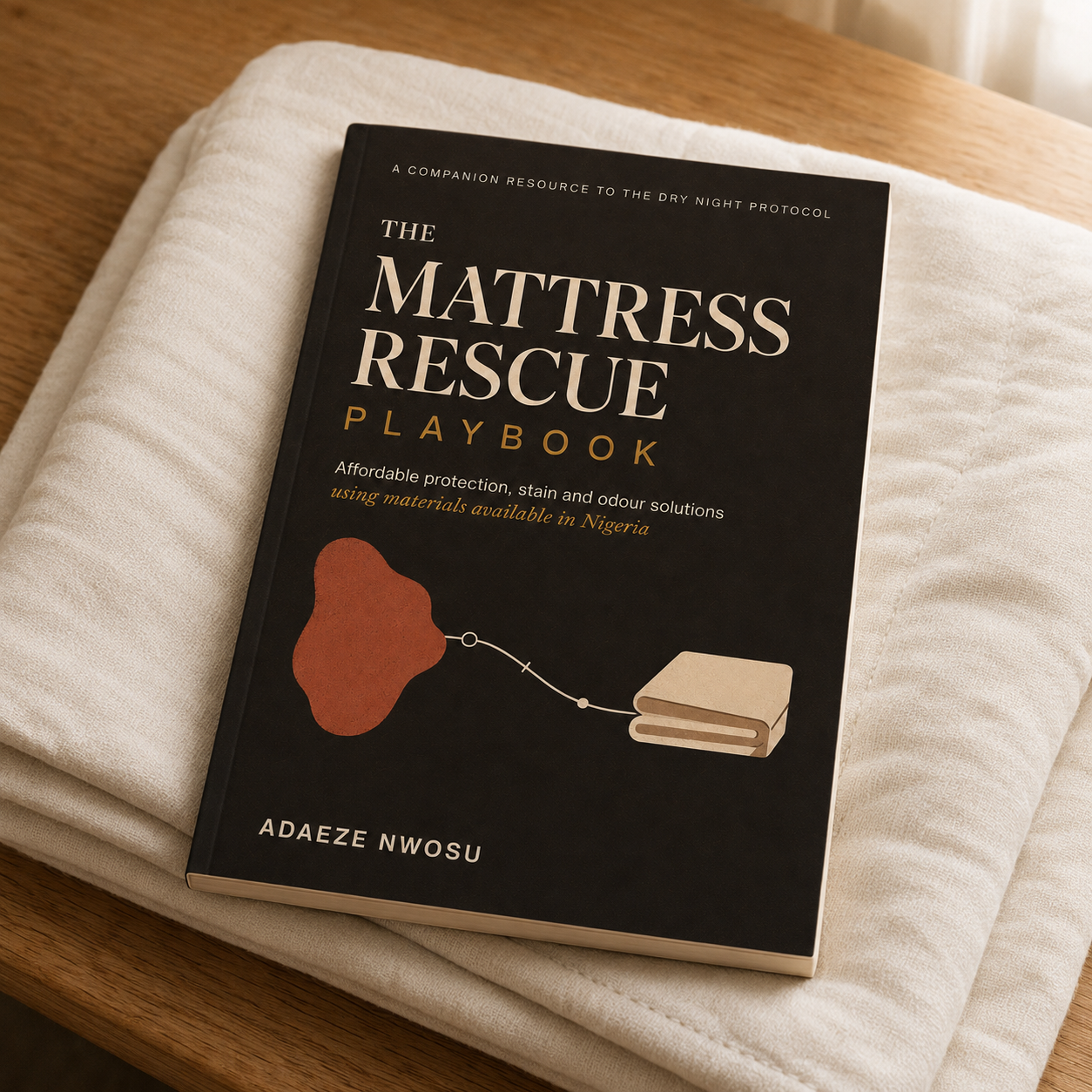
The Mattress Rescue Playbook

Affordable protection, stain and odour solutions using materials available in Nigeria.

This covers the physical side of living with night-wetting while the main plan does its work.

  • Choose affordable protection available in Nigeria
  • Make night changes faster and less disruptive
  • Deal with stains and lingering odour more effectively
  • Protect the mattress comfortably
  • Reduce repeated replacement costs

Standalone value₦5,500FREE today

The Mattress Rescue Playbook digital guide mockup

Free bonus 03

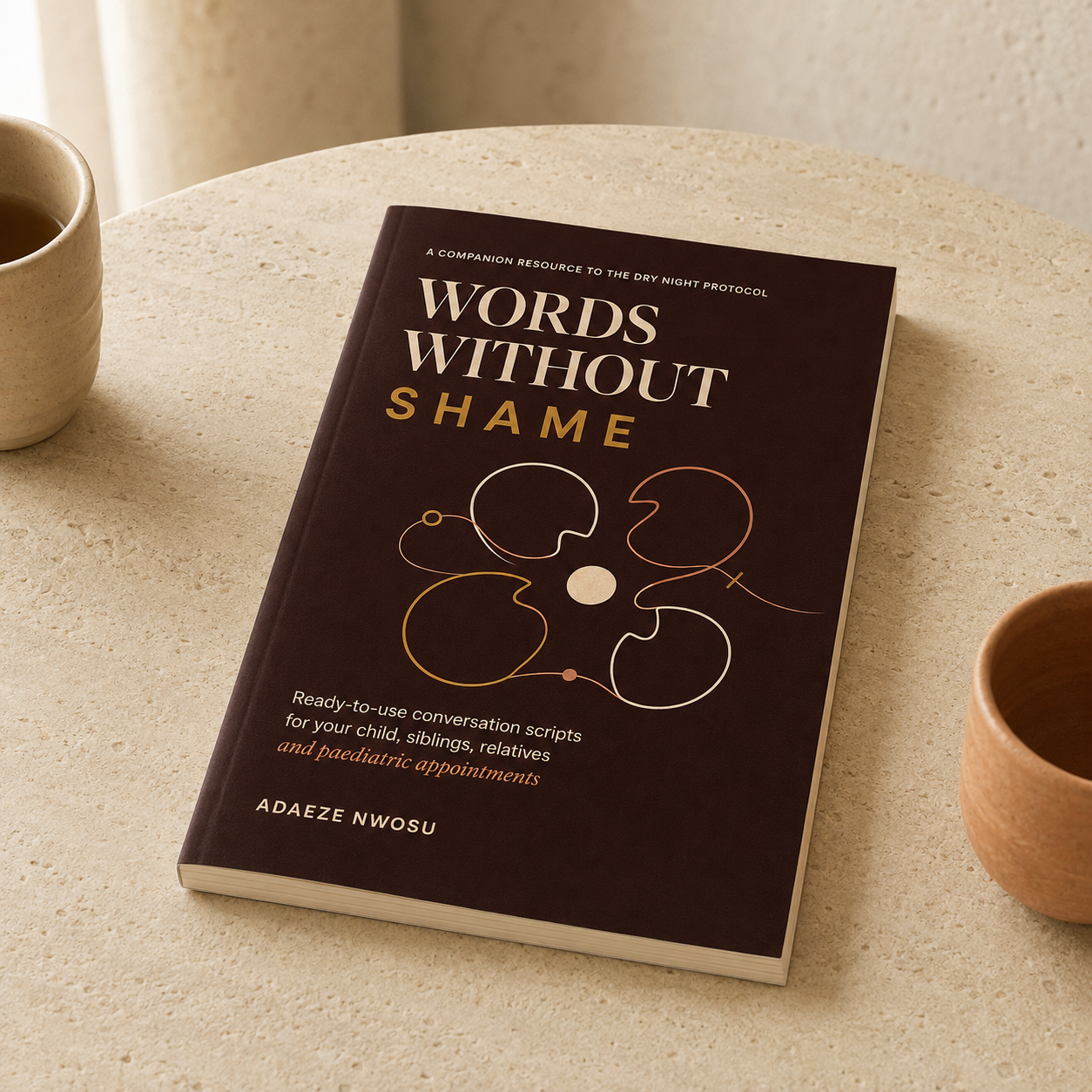
Words Without Shame

Ready-to-use conversation scripts for the child, siblings, relatives and paediatric appointments.

This is not a book about what a parent should feel. It gives language for the exact moment words are needed.

  • Explain night-wetting appropriately at different ages
  • Respond to wet mornings, setbacks and progress
  • Handle teasing, intrusive relatives and unwanted remedies
  • Prepare for a short paediatric appointment
  • Repair trust after an angry morning or past punishment

Standalone value₦4,000FREE today

Words Without Shame digital guide mockup
The complete Dry Night Protocol bundle containing four digital guides

One payment. Four practical digital guides.

The Dry Night Protocol · 67 pages₦14,900
The Nights-Away Kit · 34 pages₦6,500
The Mattress Rescue Playbook · 24 pages₦5,500
Words Without Shame · 26 pages₦4,000
Total package value₦30,900

Regular price ₦14,900Pay only ₦9,800 todayAll three bonuses are included free.

Get The Dry Night Protocol₦9,800

Secure Selar checkout · Bank transfer or card · One-time payment · Immediate access

“But ₦9,800 is still money…”

It is. But consider how easily the same amount can disappear into data top-ups, one casual outing, cinema snacks, streaming, takeaway food or one new outfit.

Those things are not wrong. But the data finishes, the outing ends, the food is eaten and clothes eventually wear out.

The Dry Night Protocol is a one-time payment. Download it once and keep it—no monthly renewal. The guides remain available for the first setup, the next school term, a future trip, a setback or a doctor’s appointment.

The real comparison is between ₦9,800 for one organised system and continuing to spend money, sleep and emotional energy on disconnected attempts.

Get The Dry Night Protocol₦9,800

Secure Selar checkout · Bank transfer or card · One-time payment · Immediate access

Questions about payment or downloading? Email sunflowerpublishingcontact@gmail.com. Please do not send a child’s medical information.

What happens after payment?

1

Pay on Selar

Complete the secure checkout by bank transfer or card.

2

Download the bundle

Use the confirmation page to download and save the ZIP file.

3

Open the main guide

Extract the four PDFs and begin with the safety and observation sections.

Digital product: The book images are presentation mockups. No physical book will be delivered.

A strong fit for

Families ready for a clear sequence

  • Parents and caregivers of children aged 5–15
  • Families who have tried restriction, lifting, rewards, remedies or waiting
  • Parents who want practical guidance grounded in published research
  • Families preparing for boarding school or travel
  • Parents willing to follow a consistent routine while protecting dignity

Not designed for

Promises this guide cannot honestly make

  • Children below age five
  • Anyone looking for a guaranteed overnight cure
  • Anyone seeking medicine doses from a PDF
  • Families unwilling to seek professional care when warning signs appear
  • Anyone expecting a physical book, alarm device or medical consultation

Evidence translated into a usable order

The Dry Night Protocol was developed as an editorial health-education resource using published clinical guidance, Nigerian research and practical family application.

It translates that evidence into a clear sequence: what can be observed at home, what should never be guessed and when professional assessment becomes the correct next step.

It is not medical advice and does not replace a doctor.

A careful note about the 48.7% figure

It applies specifically to boys with sickle cell anaemia in one Enugu study, compared with 23.1% among boys with normal haemoglobin. It is not the rate for every child with sickle cell disease, for girls or for Nigerian children generally. Affected families should involve the child’s healthcare team.

60days

The 60-day money-back guarantee

Try the guide and the relevant steps for up to 60 days. If you have tried the plan and it has not worked for your family, email sunflowerpublishingcontact@gmail.com with your Selar payment receipt and request a refund.

The full ₦9,800 purchase price will be refunded.

Get The Dry Night Protocol₦9,800

Secure Selar checkout · Bank transfer or card · One-time payment · Immediate access

Frequently asked questions

Everything important about the guide, delivery and guarantee.

Will this make every child dry in six weeks?

No honest resource can promise that. The guide provides six weeks of setup, measurement, first-line work and decision-making. Alarm learning commonly takes longer. By Week 6, the goal is visible response markers or a much clearer next step.

Who is the guide for?

It is for boys and girls aged 5–15, with age-appropriate language for younger children, preteens and teenagers. Children under five are not the intended audience for active treatment.

What if almost everything has already been tried?

That is why the guide begins with sequence rather than another isolated remedy. Many families have tried several methods without separating the broad patterns or placing the work in the correct order.

Does the bundle include an alarm?

No. The guide explains when a body-worn moisture-triggered alarm may be appropriate and how to use one correctly. Any alarm must be purchased separately.

Does the guide prescribe medicine?

No. It names medicines a clinician may discuss so parents know what questions to ask, but it gives no doses. Choice and dosing require professional assessment.

What if the child has sickle cell disease?

Use the Nigeria-specific guidance only alongside the child’s healthcare team. The family should involve the child’s clinician or haematologist.

Boarding school is only a few weeks away. Is there enough time?

There may not be enough time to promise dryness. The Nights-Away Kit can still help the family prepare discreetly while the main protocol continues.

What exactly will I receive?

A ZIP bundle containing four downloadable PDF guides. Read them on a phone, tablet or computer; printing is optional. No physical books will be delivered.

What if there is a download problem?

Email the Selar receipt and the address used for purchase to sunflowerpublishingcontact@gmail.com so the order can be checked.

How does the refund guarantee work?

Try the relevant steps for up to 60 days. If the plan has not worked for your family, email sunflowerpublishingcontact@gmail.com with the Selar payment receipt and request a refund.

Meet it with a plan instead of the same confusion

Another wet morning may still happen while this work begins. The promise is not that biology obeys a sales-page deadline.

The promise is an age-appropriate routine instead of a padlocked fridge; a safety process instead of wondering whether something important is being missed; useful observations instead of memory and guesswork.

“This is not laziness. This is not your fault. We have a plan, and we will handle it together.”

Nothing was missed. Something was never explained. Now there is a plan.

The Dry Night Protocol complete digital bundle

Get The Dry Night Protocol

And receive all three companion resources free.

Total value ₦30,900Regular price ₦14,900₦9,800 one-time151 pages · Four digital guides · 60-day money-back guarantee
Get The Dry Night Protocol₦9,800

Secure Selar checkout · Bank transfer or card · One-time payment · Immediate access